
Competing definitions
Does margin include rebates? Agree on grain, currency and timing before certifying a shared measure.
Data strategy · Architecture · Governance
Where should your enterprise turn data into decisions?
A closing balance, a group margin and a forecast can start with the same posting. Each needs a different owner, time horizon and place to run. I help teams make those choices across SAP and enterprise data platforms.
Explore the approach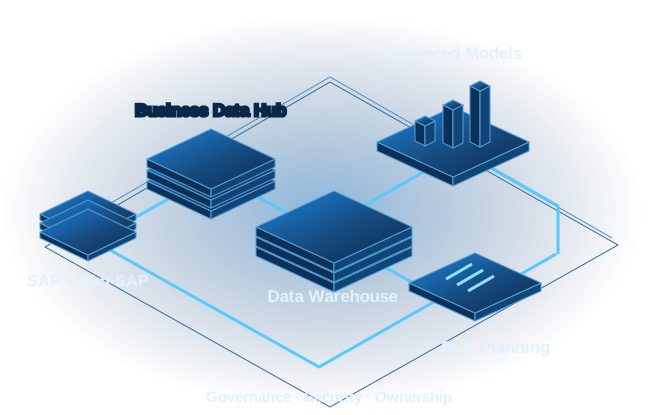
The data architecture challenge
A metric can reconcile in Finance and still tell a different story in Sales. Trace its meaning, permitted uses and operating cost before deciding where to model it.
Does margin include rebates? Agree on grain, currency and timing before certifying a shared measure.
Two teams may pay to store and transform the same postings. Give each reusable product an accountable owner.
A report can reach the warehouse through a shared identity. Test what two users with different entitlements can actually see.
When actuals change after sign-off, planners need an agreed snapshot and a record of which assumptions were approved.
Data Journey Explorer
What decision will this report support? Choose the answer you might hear in a workshop and see where the decision tree takes the request.
The collector needs current open items from SAP S/4HANA to act on a customer account.
Credit management needs comparable balances across legal entities, source systems and reporting periods.
Treasury needs to change assumptions and see how future receipts move against an approved baseline.
The request names a report, but the team cannot yet identify who will use it or what they will decide.
For a full reporting backlog, the Analytics Demand Decision Tree sets the rules. The screening workbook records the evidence, route and next action for each request so business and delivery teams can review open decisions together.
Choose the enterprise analytical center of gravity first. Then decide which responsibilities each platform can sustain.
When SAP business semantics and SAP-led processes carry most of the analytical workload, test how well a SAP-centered platform preserves meaning from source to consumer.
Prove that non-SAP history, AI workloads and external consumers can meet their service and access requirements at an acceptable cost.
When several domains already share engineering, compute and operations, test the enterprise platform as the primary analytical environment.
Measure the effort to retain SAP semantics, reconcile deltas and enforce identity across the boundary. Include exit costs and the skills needed to run both sides.
Where does SAP Business Data Cloud fit? It can lead SAP-centric analytics, supply contracted products to an enterprise platform, or serve a specialized SAP workload. Justify coexistence with a representative proof of concept, a consumer contract and an owner for recurring costs.
The Agnostic Informational Architecture separates logical responsibilities from deployment choices. Its Enterprise Analytical Environment gives each producer, model and consumer a place in the design.
Map the decision, users, sources and current cost of serving it.
Place acquisition, history, advanced models and consumption. Assign ownership at each handoff.
Run the same workload on viable platforms. Compare freshness, identity, cost and reversibility.
Certify grain, definitions, access and change contracts before releasing a data product.
Monitor delays, failed loads and spend. Name the team that reconciles and restores service.
Explore the research behind these logical responsibilities in Research & Publications.
The strategy framework sets the direction. The decision tree defines where each request belongs, and the screening workbook applies those rules report by report. The three handbooks guide platform delivery.
Which analytical architecture best fits your enterprise?
Which path should this information need follow?
Where does each requested report belong, and what evidence supports that decision?
What role should SAP BDC play in your enterprise?
How do you make Datasphere production-ready?
How can planners use trusted actuals and control the approved result?
Illustrative examples of how the approach applies to recurring architecture problems.
Finance wants a shared margin figure across company codes. Compare candidate SAP-managed products against the required grain and coverage. Certify the chosen measure with Finance and record who handles upstream changes.
An enterprise platform already joins sales and logistics. Keep cross-domain analysis there if a PoC can reconcile SAP postings and preserve effective access. Give the boundary a versioned contract and a recovery owner.
Treasury needs to rerun its cash forecast after a late close. Pin the actuals snapshot, separate working and approved versions, and reconcile any authorized publication against the signed-off plan.