
Business authority
Which system owns the decision, the data and the posting? Which checks must run before the SAP transaction commits?
Extensibility & platform governance
Extend SAP without compromising the next upgrade.
Decide what stays in the SAP transaction, what deserves its own lifecycle and how each extension will be secured, released and operated.
Explore extension choices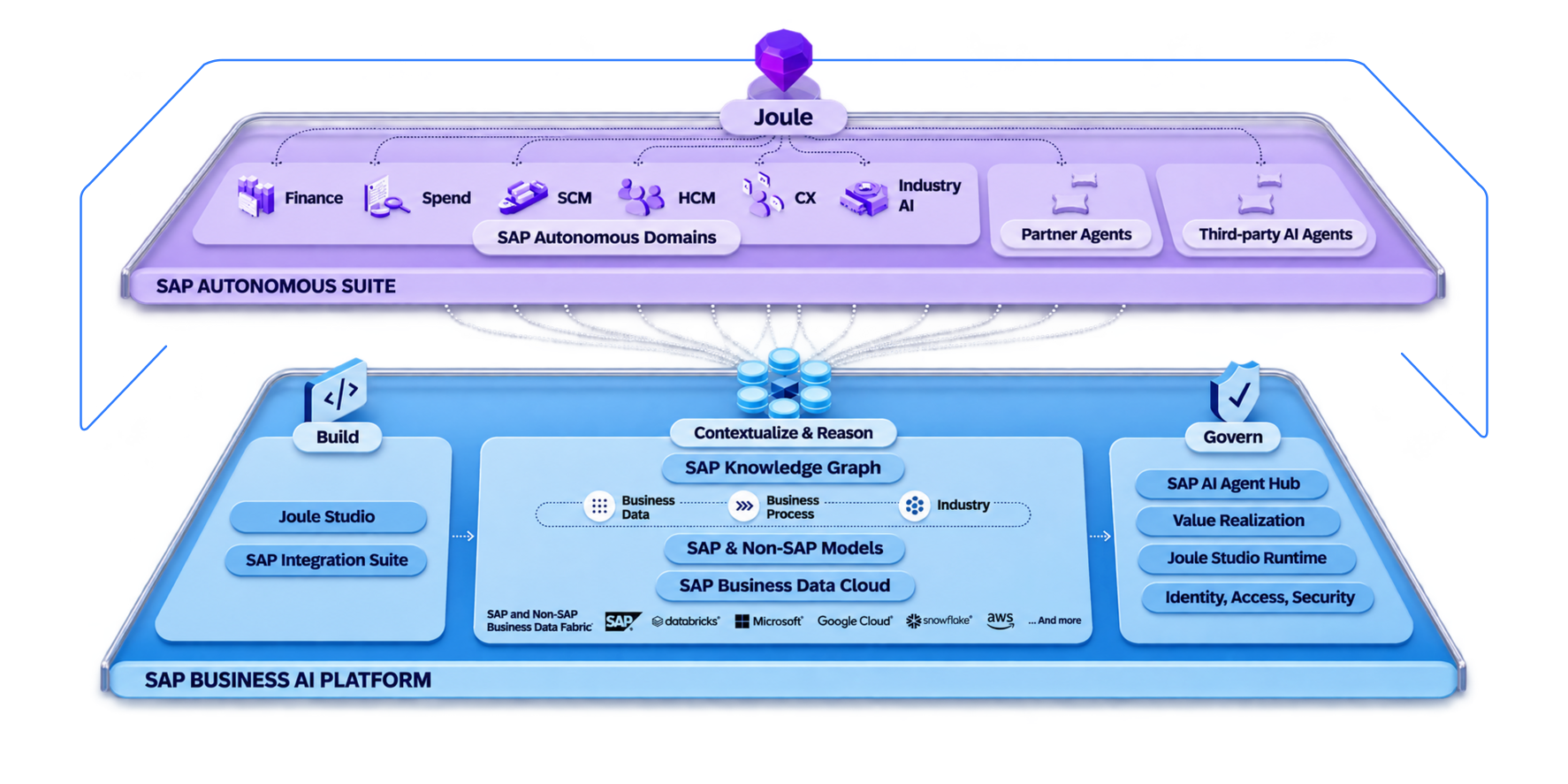
The strongest placement decision starts with what must happen inside the SAP transaction and what can run independently through a supported contract.
Which system owns the decision, the data and the posting? Which checks must run before the SAP transaction commits?
Which SAP objects does the extension depend on? Verify the release and support status for the target edition and version.
Who deploys the extension, operates it and handles failed exchanges? What does that operating model cost?
Extensibility Decision Explorer
Check standard fit first. Compare supported in-app changes, local developer extensions and side-by-side applications as the requirement warrants.
Architecture challenge
The requirement can be met by an existing SAP process or a supported configuration choice.
Architecture challenge
A supported field, layout or rule is needed inside an existing SAP process.
Architecture challenge
The rule must participate in SAP-local processing, or the extension needs a local business object.
Architecture challenge
The application or workflow needs its own lifecycle and can interact with SAP through supported remote contracts.
For an independent application, SAP-centric landscapes may evaluate SAP BTP capabilities first. Enterprises with established application platforms may start there. In either case, verify the SAP-side contract, operational fit and total cost.
SAP Business AI Platform (BAIP) brings together capabilities for applications, integration, data and AI. SAP Business Technology Platform (BTP) capabilities are a core part of that portfolio and retain their own account model.
Organize directories around accountable domains and separate production from non-production in subaccounts.
Map each service to its provisioning model. Register separately provisioned services, such as SAP Business Data Cloud where applicable, with their owners, region, trust and entitlements.
Confirm promotion and recovery per service, with named operators and cost owners. For agent workloads, define permitted actions, access to business context, evaluation and human oversight.
Translate the placement decision into checks that delivery and operations teams can verify before the extension goes live.
A placement framework, a platform governance guide and engineering standards that make the decision reviewable and executable.
A decision framework for placing extensions in SAP and enterprise landscapes.
A guide for adopting and operating platform services, with explicit ownership and boundaries.
Engineering guidance for translating an approved on-stack design into reviewable ABAP.
Two illustrative examples show how transaction ownership changes the placement decision.
Check configuration and a supported in-app rule first. If developer logic must run during the posting, evaluate a released local extension point and keep the approved rule within the transaction. Test both the accepted and rejected posting paths.
Run the approval in an independent workflow when its lifecycle spans multiple systems. Use a released interface for the resulting SAP action, keep SAP authoritative for the posting, and assign ownership for retries and reconciliation.